

Your bed isn't a store size
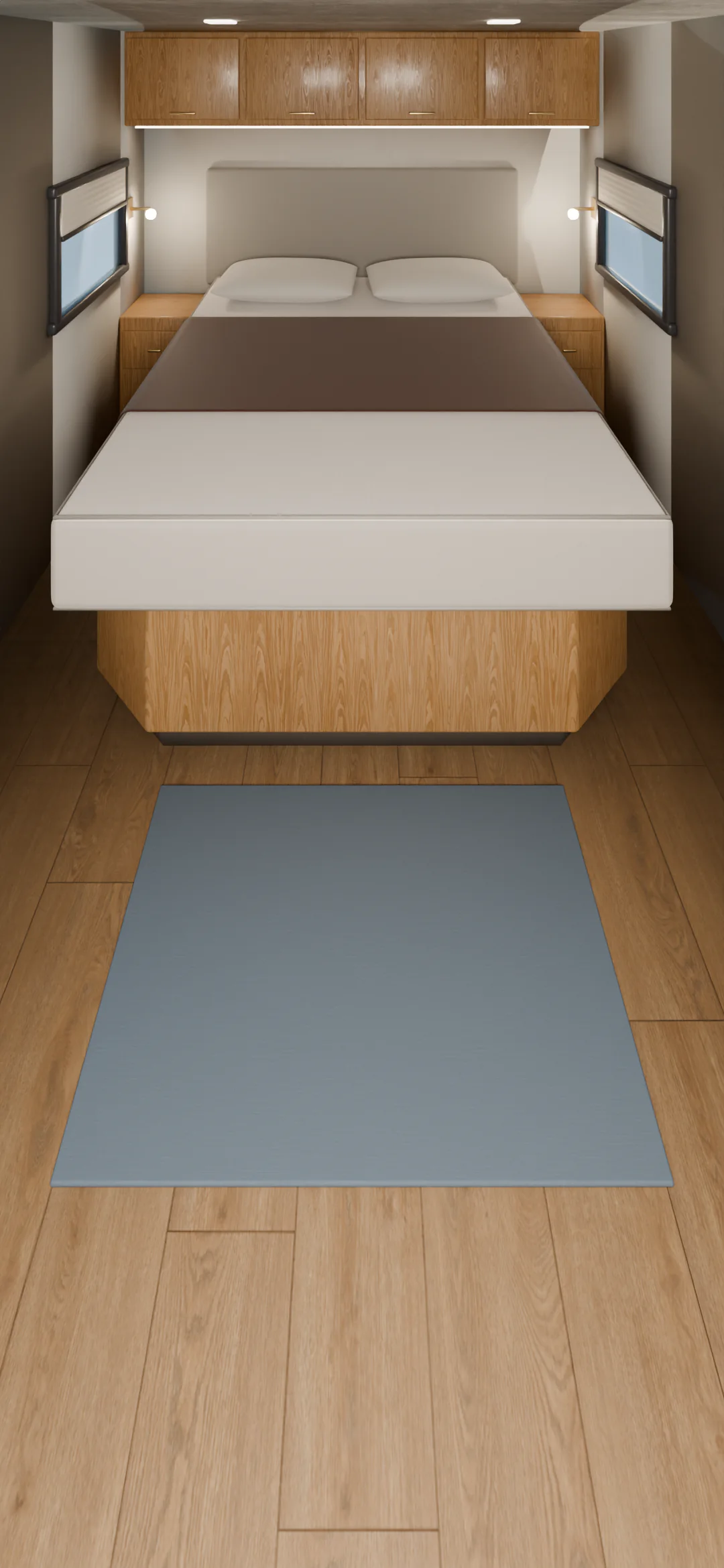
This RV bed has both foot corners cut so you can walk past. A store queen, 60 × 80 in (152 × 203 cm), rides over both cuts and hangs past the foot.
This V-berth narrows to a point in the bow. Even a wide rectangle, an RV king at 72 × 80 in (183 × 203 cm), hangs over both sides of the V.
This iron bed is an old size. A store twin, 38 × 75 in (97 × 191 cm), is too wide for its rails and rides up over them.
A wall bed takes a queen-sized frame, but it has to close. The size can be right and the mattress still wrong: too thick or too heavy, and the bed will not fold.
hangs overleaves a gap
Made to its shape, it fits.
Same room, same bed. The mattress follows the platform: both cut corners, the true length, nothing hanging over.
Same cabin, same berth. The mattress follows the V: wide at the head, narrow in the bow, nothing over the edge.
Same frame, same spring. The mattress drops inside the rails, the length the frame really has.
Same wall, same frame. The mattress is the size of the frame and thin enough to close inside the cabinet.
- Both cut corners
- The true length
- Nothing hangs over
Which bed is yours?
Each one is a real room. Pick yours and the rest of the page uses it.
What makes a RV bed odd.
- An RV short queen is 60 × 75 in (152 × 191 cm); a home queen is 60 × 80 in (152 × 203 cm). Same width, shorter, and many RV beds also cut their foot corners for the walkway.
- Bunks are worse: RV bunk mattresses have no standard size and vary from one RV to the next.
- No two are alike: V-berth mattresses are not symmetrical: left and right mirror each other and the angle varies by boat.
- Thickness matters in a cabin: typically 4–6 in (10–15 cm); thicker eats headroom, and most liveaboards settle at 5 in (13 cm).
- The reliable way to capture it: lay cardboard or kraft paper into the berth, press it into every corner, trace against the hull and cabinetry, cut, confirm the fit, then measure the template at its widest, narrowest and longest.
- Old sizes are not today's sizes: three-quarter beds were common from the late 1800s through the 1930s, and a three-quarter is 48 × 75 in (122 × 191 cm).
- Old frames are rarely exact either: antique frames often deviate from the nominal size by an inch or two.
- A wall bed is a machine. One maker's limit is up to 12 in (30 cm) thick; other makers set other limits: ask the maker of your bed.
- Weight counts too, between 50 and 100 lb (23–45 kg) for a queen: too light and the bed will not stay open; too heavy and it may not close properly.
- Measure the thickness that really closes: lay a broomstick across the mattress and measure from the base to the stick, so the centre pillowing counts.
Every odd shape starts the same way: measure inside the frame, then each corner that is not square. The templates guide shows the five common shapes.
Measure your RV bed.
- Inside, rail to rail. Not the old mattress.
- Head to foot, down the middle.
- The room above it: how thick it can be.
- Every corner that isn't square: both sides of the cut.
- Across the widest point, at the head.
- Down the middle, head to bow.
- The headroom above the berth.
- The narrow end, at the bow.
- Inside the rails, side to side.
- Head rail to foot rail, inside.
- From the spring to the top of the foot rail.
- Each corner: is the frame square?
- Inside the frame, side to side.
- Inside the frame, head to foot.
- The thickness that still closes.
- Ask the maker of the bed its weight limit.
Type your numbers.
The mattress in the room takes your shape as you type.
A store size, or made to shape?
hangs overleaves a gap
Before you order.
Questions worth asking any maker, wherever you buy.
- Do you work from my measurements, or from a paper template of the bed?
- How do you finish a cut corner or a curve? The cover should follow the shape.
- Will the thickness fit the room above the bed, and still close if it folds?
- How does it get in? It has to pass the door, the hatch or the stairs.
- What happens if one of my measurements is off?
Keep your RV bed's shape.
Your shape sheet holds every number, drawn to scale. Take it to any maker, or keep the link and come back to it.
Measure once. Draw the shape. Have it made to fit.
Guides
How to measure a bed for a custom mattress
Four measurements, taken inside the frame, twice. The method that works for any bed.
Mattress size chart — Canada, RV and older sizes
Every standard size, every RV size and the older three-quarter, drawn over each other to scale, with the source for each number.
RV and camper mattresses: sizes, cut corners and how to measure
Short queen, RV king, bunks that follow no standard, and the two corners the walkway cuts off. Drawn, with the numbers' sources.
Boat mattresses: the V-berth, the template method, thickness
A V-berth is not symmetrical and no two are alike. The cardboard template method, the dimension ranges you will see, and why thickness is a trade.
Murphy bed mattresses: thickness, weight and how to measure the cabinet
A wall bed is a machine: the mattress has to be light enough to lift and heavy enough to stay down. The limits, where they come from, and the broomstick trick.
Antique bed mattresses: the three-quarter and the inch that is missing
Old frames were built to sizes nobody sells any more. What a three-quarter bed is, why antique doubles come up short, and how to measure a frame with slats, rails or a rope.
Odd-shape templates: cut corner, notch, rounded, hinged, V-berth
The five shapes that cover almost every odd bed, each drawn with the numbers a maker needs. Print the page or build the shape in the tool.
Your bedMattress sizing tool: draw your shape, get the sheet
Enter your measurements, see the shape to scale, find the nearest standard size, and print a sheet a maker can work from. Share the link.